 : +1 308-7304-232
 : +44 (744)-139-7094
 : +61 4 8080-3582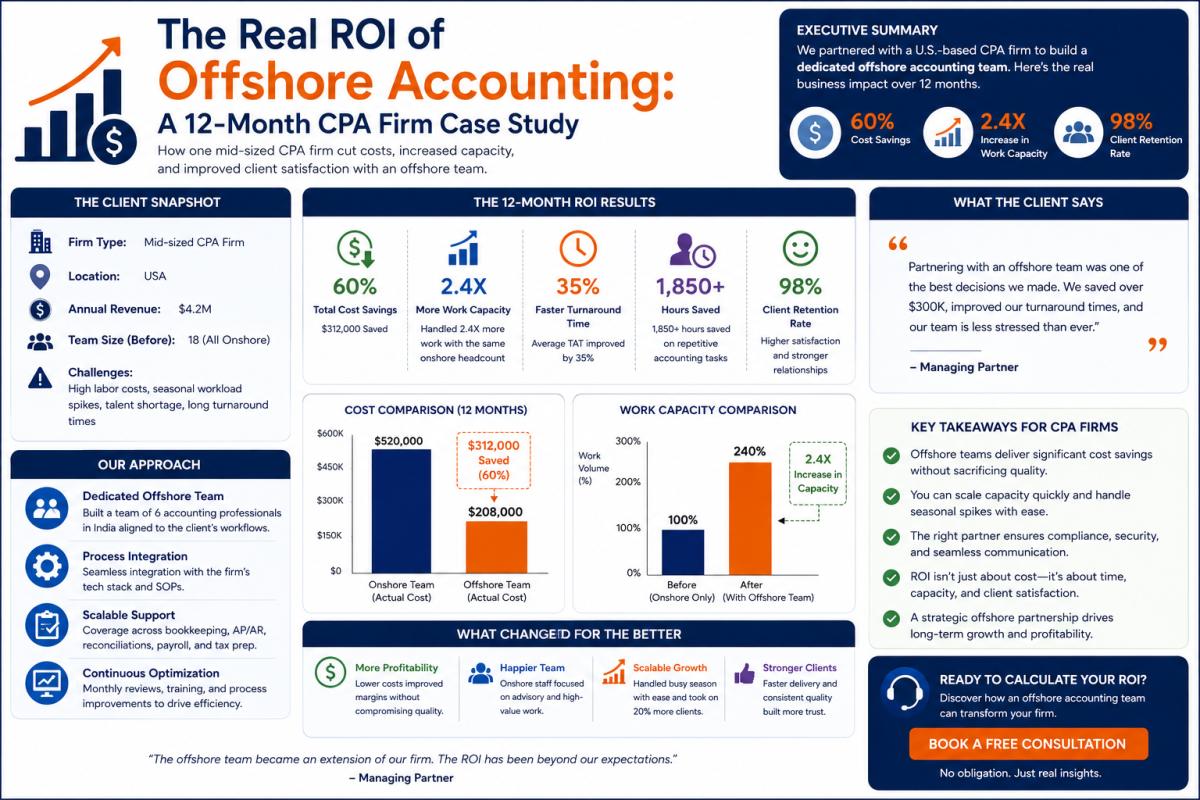
Offshore Accounting ROI: A 12-Month Case Study in Cost, Retention, and Growth
Most conversations around offshore accounting ROI start and end with a single number: "you'll save 50–60% on labor costs." It's not wrong, exactly — but it's incomplete in a way that quietly costs firms real money.
Two things get left out almost every time. First, offshore teams take time to ramp up, so the savings don't show up on day one — firms that model ROI as an immediate line-item cut are setting themselves up for disappointment in month one and pleasant surprise by month six. Second, and more importantly, the value of capacity and retention is almost never priced into the calculation at all, even though for many firms it ends up being the largest source of return.
This case study walks through a realistic, composite scenario — built from patterns we've observed across firms exploring offshore accounting teams — to show exactly how and when each of those ROI components actually shows up.
Meet Harbor & Associates: The Firm Behind This Case Study
Harbor & Associates is a regional CPA practice with 3 partners and 12 local staff, processing roughly 1,400 individual and small business returns per season. Before investing in an offshore team, the firm was stuck: staff capacity constraints meant they were turning away new business every year, and local staff were burning out at 55–65 hour weeks during peak season. The bill came due in the off-season, when two staff members walked out the door immediately after tax season wrapped.
This is a familiar story for firms of nearly any size. The question isn't whether the pressure is real — it's what a firm actually does about it, and how quickly a fix like offshore staffing pays for itself.
Baseline Metrics Before Going Offshore
| Baseline Metric | Value |
|---|---|
| Local staff | 12 total (3 partners, 9 staff) |
| Returns processed per season | ~1,400 individual/small business returns |
| Average cost per return | ~$145, fully loaded |
| Peak season weekly hours (staff) | 55–65 hours |
| Post-season staff turnover | 2 of 9 staff (22%) |
| New clients turned away (prior season) | ~35 estimated |
The 12-Month Offshore Integration Timeline
ROI from an offshore accounting team rarely shows up as a straight line. It moves in stages — onboarding, break-even, retention gains, and eventually expansion. Here's how that played out over Harbor's first year.
1–2
3–4
5–6
7–9
10–12
Before vs. After: The 12-Month Metrics Comparison
| Metric | Before | After 12 Months |
|---|---|---|
| Average cost per return | ~$145 | ~$87 (↓40%) |
| Peak season weekly hours | 55–65 hrs | 45–50 hrs |
| Post-season staff turnover | 22% (2 of 9) | 0% |
| New clients onboarded | Turned away ~35 | +22% client base |
| Local headcount | 12 | 12 (unchanged) |
Where the ROI Actually Came From
Break the results down and three distinct ROI streams emerge — and only one of them is the "obvious" savings most firms model for.
Direct Savings: The Obvious ROI
Reduced labor costs from the offshore team, combined with fewer local hours during peak season, paid back the initial investment within the first year — with the largest single chunk of that savings coming from reduced peak-season payroll.
Retention Savings: The Hidden ROI
Fewer local hours meant better retention: zero off-season turnover in year two, versus 22% in year one. Retention value is hard to put a clean number on, but the cost of replacing a departed employee — recruiting, training, rebuilding client relationships — is real and often underweighted.
Revenue Growth: The Real ROI
The largest source of value by far was capacity. Freed-up local time let the firm grow its client base by 22% — with zero additional local headcount.
What This Case Study Represents — And What It Doesn't
This hypothetical scenario is built to reflect the pattern we see across most offshore accounting ROI stories: savings begin within the first year, and reduced local hours tend to improve retention during peak season specifically. But every firm's starting point is different. Your existing cost per return, service mix, ability to convert freed-up capacity into new clients or higher prices, and the pace at which you integrate an offshore team will all shape your own ROI timeline — sometimes significantly.
Additional Insights From Offshore ROI Patterns
- Break-even happens faster than most firms expect — frequently within the first tax season, not after a full year.
- Retention savings are a real, if hard-to-quantify, ROI driver — especially for firms operating on tighter margins.
- Most firms underestimate the value of capacity, particularly the growth opportunities it unlocks: new clients, higher prices, or new service lines.
- Firms that don't integrate offshore staff into day-to-day operations see delayed ROI, since the offshore team's time can't be fully utilized.
- Scaling too aggressively backfires. Adding more offshore hires before the first cohort is fully integrated leads to underutilization, particularly early on.
Frequently Asked Questions
How long does it take to see ROI from an offshore accounting team?
Most firms see meaningful cost savings within the first 1–2 months of onboarding, with break-even typically occurring during the first tax season if the offshore team is utilized strategically.
Is retention savings really an ROI factor?
Yes — even though it rarely comes up in offshore ROI conversations, since it isn't an immediate cash saving. Replacing a departed employee carries real costs, especially for firms using a direct-hire model.
Does this apply to small firms as well?
Yes. For smaller firms the absolute dollar savings will be lower, but the percentage reduction in direct labor costs from adding one offshore bookkeeper is roughly comparable whether you're a 2-person firm or a 12-person firm.
What's the most common ROI calculation mistake firms make?
Only comparing local versus offshore hourly rates. Firms that model ROI this narrowly are frequently surprised to find their actual ROI was much higher once capacity and retention are factored in.
Why include retention savings in the metrics at all?
Because reduced staff turnover lowers the real costs of replacing employees and reduces the disruption clients experience when their point of contact changes — both of which have measurable financial impact, even if neither shows up as a single obvious line item.
Conclusion
The ROI of an offshore accounting team is made up of more than direct labor cost savings. Beyond reduced payroll, offshore teams can meaningfully reduce staff turnover during peak season and free up the capacity firms need to grow their client base and revenue. A complete offshore ROI calculation has to account for all three factors together. Any analysis that looks only at direct labor costs while ignoring the impact on retention and capacity is almost guaranteed to underestimate the real return.
If you'd like to see how these trends might apply to your firm's specific circumstances, request a demo or consult to walk through your projected ROI in detail.
Ready to Scale Your Business?
Connect with our experts to learn how our outsourcing solutions can drive growth.
BOOK A DISCOVERY CALL