 : +1 308-7304-232
 : +44 (744)-139-7094
 : +61 4 8080-3582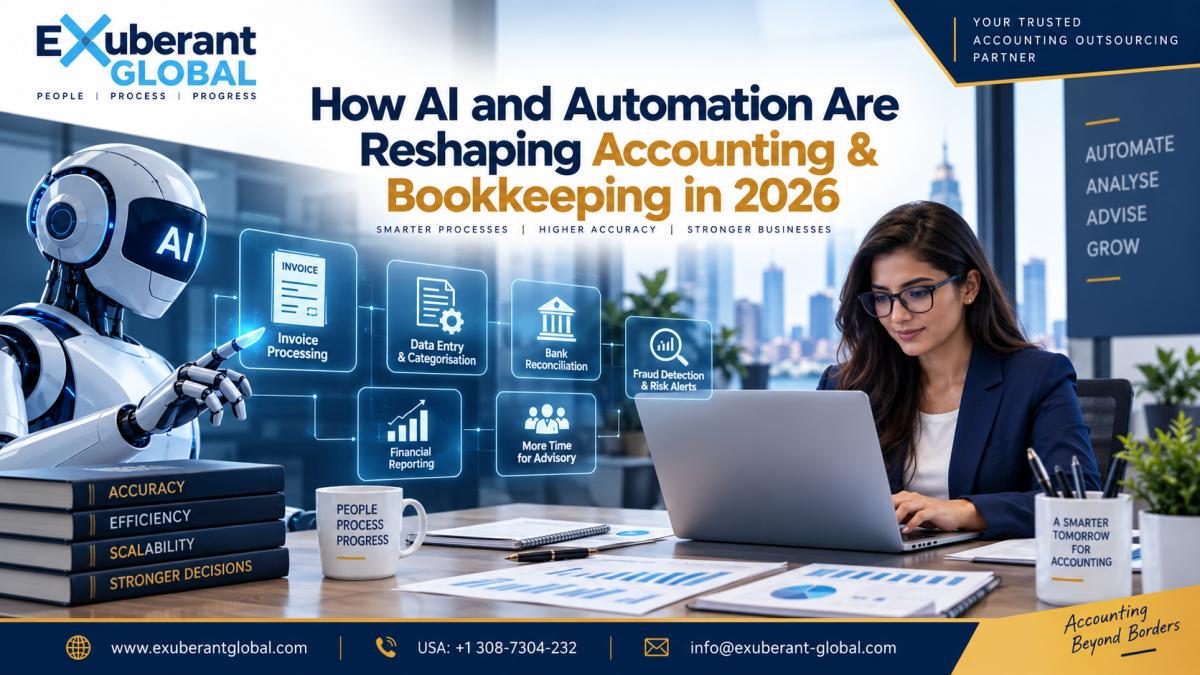
How AI and Automation Are Reshaping Accounting & Bookkeeping in 2026
Two years ago, "AI in accounting" mostly meant a chatbot bolted onto your software's help menu. That's no longer what it means. In 2026, AI-powered bookkeeping tools reconcile bank feeds daily instead of monthly, extract and categorize invoices without a human touching them, and flag anomalies before they turn into a bad quarter — and a growing share of accounting teams are running at least part of their monthly close on autopilot.
The question for most firms and finance teams isn't Should we adopt AI in accounting?" anymore. It's which parts of the work are actually safe to automate, which still need a trained person reviewing the output, and how this shift toward automated bookkeeping changes the way businesses staff and budget for accounting going forward. This guide walks through exactly where things stand right now — what's automated, what isn't, what's coming next, and how to actually put it to work.
What's Actually Automated Today
Not every AI accounting claim holds up under scrutiny, but a specific set of bookkeeping automation tasks has moved from "assisted" to "largely automatic" across most modern platforms.
What Still Needs a Human
The tasks that resist full automation aren't the mechanical ones—they're the ones that require judgment, context, or a relationship.
-
Ambiguous categorization calls—a transaction that could reasonably sit in two different accounts—still need a person who knows the business.
Complex or multi-entity tax planning — AI handles standard filings well; scenario planning and structuring still sit with a qualified preparer.
Client relationships and advisory conversations — explaining what the numbers mean for a business's next decision is still a human skill.
Exception handling — when automation flags something it can't resolve, someone still has to investigate and make the call.
Judgment-heavy audit prep: AI can assemble the underlying data, but forming an opinion on materiality and risk stays with a human reviewer.
Industry surveys on AI adoption in accounting consistently report the same pattern: firms see real productivity gains, but almost all of them keep a human reviewing AI output before it goes final — oversight hasn't gone away; it's just moved to a different point in the workflow.
The Next Shift: Agentic AI and Continuous Accounting
The frontier in 2026 isn't AI that answers questions when asked — it's AI that acts on its own within defined limits. An agentic AI accounting tool can detect an anomaly, investigate where it came from, flag it for review, and draft the corrective journal entry, all before a human opens the file. This is still early-stage and largely confined to pilot programs at more advanced firms, but it's no longer a future concept — it's running in production at a small number of early adopters right now.
That capability is what's enabling a broader shift, some are calling continuous accounting: instead of books that are current once a month at close, books that are current every day, with variance analysis happening in near real time. The "month-end crunch" starts to disappear when nothing has been piling up all month waiting to be reconciled.
AI Bookkeeping Tools: What the Market Looks Like in 2026
The current AI bookkeeping software landscape roughly splits into three categories, each suited to a different kind of business.
Assistive AI in existing software
AI features are layered into platforms like QuickBooks or Xero: auto-categorization, anomaly flags, and smart search.
Best fit: Businesses already invested in a mainstream accounting platform.
Standalone AI bookkeeping platforms
Purpose-built tools that automate the majority of the books end-to-end, often with a human review layer included.
Best fit: Startups and small businesses wanting minimal manual involvement.
AI-augmented outsourced teams
A human bookkeeping team uses AI tools internally to work faster, but the client relationship and final review stay human.
Best fit: Businesses that want automation's speed without losing a dedicated point of contact.
Why This Is Happening Now, Not Later
1. The economics finally work for smaller businesses.
AI-driven accounting automation used to be an enterprise-budget tool. Cloud-based platforms have brought real-time visibility and automated workflows down to a price point small businesses and startups can actually afford, which is now the primary driver of adoption—not large enterprises, but smaller businesses catching up.
2. Regulation is pushing digital-first bookkeeping from "nice to have" to required.
Digital reporting mandates — expanding requirements like the UK's Making Tax Digital, the EU's e-invoicing rules, and the IRS's growing emphasis on digital data matching — are making automated, always-current transaction tracking closer to a compliance requirement than an optional efficiency play.
3. The talent shortage makes the case on its own.
With fewer people entering the accounting profession and firms already stretched thin, automating the mechanical parts of bookkeeping isn't just about margin — it's often the only way to keep up with client volume without proportionally growing headcount.
Where Automation Moves Fastest, by Industry
-
E-commerce — high transaction volume across multiple payment processors and marketplaces makes automated reconciliation especially valuable; manual matching simply can't keep pace with order volume.
Professional services — time-and-billing data flows more cleanly into automated invoicing and expense tracking, freeing up time for client-facing work.
Real estate — automated categorization handles the high volume of recurring, predictable transactions (rent, maintenance, utilities) well, while judgment-heavy items like capital improvements still need review.
Healthcare practices — automation helps with the volume of insurance-related transactions, though compliance requirements keep human review tightly in the loop.
A Short Glossary: AI Accounting Terms Worth Knowing
-
OCR (Optical Character Recognition)—the technology that reads text from scanned receipts and invoices so it can be entered into your books automatically.
Agentic AI—AI that can take multi-step action on its own (investigate, flag, draft a fix) rather than just answering a question when asked.
Continuous accounting—a workflow where books are reconciled and current every day instead of caught up once a month at close.
Machine learning (ML) categorization: a model that learns a business's historical transaction patterns to auto-assign new transactions to the right account.
Digital reporting mandate—a government requirement (like the UK's Making Tax Digital) that businesses submit financial data in a structured digital format rather than on paper.
How to Start Automating Your Bookkeeping: A Practical Sequence
-
Connect your bank and card feeds directly to your accounting software so transactions flow in automatically instead of being keyed in by hand.
Turn on AI-assisted categorization and spend the first few weeks correcting its mistakes — this is what trains it to your specific business.
Automate invoice and receipt capture through OCR so paperwork doesn't pile up waiting for someone to enter it.
Set up anomaly alerts so unusual transactions get flagged the day they happen, not the day someone finally reviews the ledger.
Keep a defined human review step before anything is finalized, especially for tax filings and financial statements.
What This Means for How Businesses Choose a Bookkeeping Partner
The practical effect of all this isn't fewer bookkeepers." It's a change in what bookkeepers spend their time on. As routine categorization, reconciliation, and standard filings get automated, the value in a bookkeeping relationship shifts toward review, judgment, and advisory, which means the quality of the human reviewing the AI's work matters more, not less.
For businesses evaluating a bookkeeping partner in 2026, that changes the question worth asking. It's no longer just "do you use AI tools"—most providers now do. It's "who is reviewing what the AI produces, and how deep is that review before it reaches me?"
Where Exuberant Global fits in
Exuberant Global builds dedicated bookkeeping teams that work inside the software you already use — QuickBooks, Xero, or Sage — combining automated data capture with a multi-level human review before anything reaches you. The goal isn't replacing the reviewer with AI; it's giving your reviewer better, faster inputs to work with.
Frequently Asked Questions
Is AI going to replace bookkeepers?
Most current evidence points to AI automating specific tasks — reconciliation, data entry, standard categorization — rather than replacing the role outright. Firms report the skill mix is shifting toward review and advisory work rather than the job disappearing.
What accounting tasks are safe to fully automate right now?
Bank reconciliation, transaction data entry, and invoice/receipt processing are the most mature. Complex tax planning, ambiguous categorization, and client advisory conversations still benefit from human judgment.
What is "continuous accounting"?
It's the shift from books that are current once a month to close to books that are updated and reconciled daily, removing the traditional month-end crunch.
What is agentic AI in accounting?
Agentic AI refers to tools that can take multi-step action on their own — detecting an issue, investigating its cause, and drafting a fix — rather than only responding when prompted. It's still early-stage but already running in pilot form at some firms.
Do small businesses need to worry about digital reporting mandates?
Increasingly, yes. Expanding digital-reporting requirements in several jurisdictions are making automated, always-current transaction tracking closer to a baseline expectation than an optional upgrade.
How do I evaluate whether a bookkeeping provider's AI use is actually reliable?
Ask specifically what's automated, what a human reviews before it reaches you, and how discrepancies get flagged and resolved—not just whether they "use AI."
Will automation make outsourced bookkeeping cheaper?
Automation tends to reduce the time spent on mechanical tasks, which can lower costs or redirect that time toward higher-value review and advisory work, depending on how a provider structures its pricing.
Ready to Scale Your Business?
Connect with our experts to learn how our outsourcing solutions can drive growth.
BOOK A DISCOVERY CALL