 : +1 308-7304-232
 : +44 (744)-139-7094
 : +61 4 8080-3582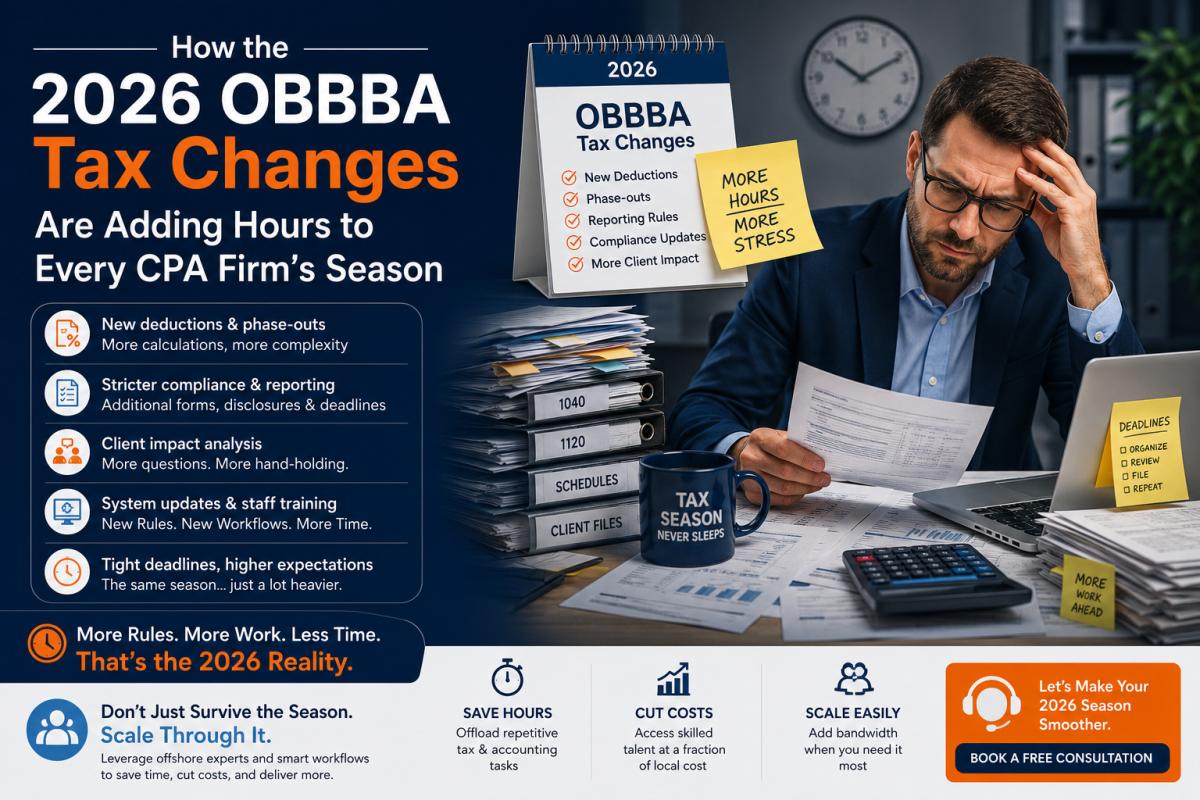
Disclaimer: This article is written for CPA and accounting firm owners to understand the operational and workload impact of the 2026 tax season. It is general information, not tax, legal, or accounting advice, and is not a substitute for reviewing official IRS guidance for your specific clients. Some provisions are still being clarified through IRS guidance, and state-level treatment varies. Please verify current details on IRS.gov before advising clients or finalizing returns.
Every filing season brings some kind of change. Tax brackets shift, standard deductions get adjusted for inflation, and a form gets renumbered. Firms absorb it, adjust their checklists, and move on. The 2026 season is different — not because any single rule is especially hard to understand, but because several brand-new provisions are landing on a large share of individual returns at once, and each one comes with its own eligibility test, documentation requirement, and calculation. None of it is complicated in isolation. All of it together is what's adding real hours to this season's workload.
For CPA firms that are already dealing with a shrinking talent pipeline and staff stretched thin during tax season, that extra workload doesn't land on fresh capacity — it lands directly on a team that was already at its limit last year. This article breaks down exactly what changed under the One Big Beautiful Bill Act (OBBBA), why it's adding measurable hours to this season, and what firms are doing to absorb that capacity without losing staff or client trust in the process.
Quick summary: 4 new individual deductions, 1 new form (Schedule 1-A), new W-2 and 1098-VLI reporting requirements, an updated Form W-4, and inconsistent state conformity — all temporary, expiring after tax year 2028.
What Is the OBBBA in Plain Terms?
The One Big Beautiful Bill Act (Public Law 119-21) was signed into law on July 4, 2025. It's a broad piece of tax legislation that permanently extended several provisions from the 2017 Tax Cuts and Jobs Act while also introducing a handful of brand-new, temporary individual deductions that didn't exist in the tax code before. Most of these new deductions technically applied starting with the 2025 tax year, but the IRS granted transition relief for that first year while forms, withholding tables, and reporting requirements were being finalized. 2026 is the first season where the full reporting requirements, new IRS forms, and payroll documentation rules are actually in effect — which is exactly why this season feels noticeably heavier than last year's, even though the underlying law hasn't changed.
The IRS maintains an official hub page summarizing these provisions, which is worth bookmarking for your team and referring clients to directly: IRS.gov – One Big Beautiful Bill Provisions.
Timeline: How We Got Here
This matters operationally: 2025 returns were prepared under relaxed penalty rules while the IRS and payroll industry adjusted. Firms that treated 2025 as a "trial run" and didn't tighten their documentation process are now facing the full weight of the requirements this season, with far less room for error.
The 4 New Deductions Every Firm Now Has to Process
OBBBA created four new above-the-line deductions, all claimed on a brand-new form — Schedule 1-A, Additional Deductions — available whether a client itemizes or takes the standard deduction. Each one is temporary, applying to tax years 2025 through 2028, and each has its own income phase-out and documentation requirement.
| Deduction | Cap | Must Verify |
|---|---|---|
| Tips | $25,000 | Voluntary cash tips only; income under ~$150k/$300k |
| Overtime | $12,500 / $25,000 MFJ | Only the "premium" half qualifies, not full OT pay |
| Car Loan Interest | $10,000 | US-assembled vehicle; needs Form 1098-VLI |
| Senior (65+) | $6,000 | Stacks on standard deduction; Social Security still taxable |
Tips deduction, in more detail
The tips deduction only applies to occupations that customarily and regularly received tips as of December 31, 2024, based on IRS proposed regulations. Mandatory service charges — the automatic 18% added to a large party's restaurant bill, for example — do not qualify, but tips distributed through a tip-sharing arrangement do. This distinction alone requires a preparer to actually understand how a client's employer structures its tip pooling, which isn't always obvious from a W-2 alone.
Overtime deduction, in more detail
This one trips up a lot of clients because of how it's worded. It's not a deduction for overtime pay — it's a deduction for the overtime premium, meaning only the extra "half" in a standard time-and-a-half calculation. A client who worked significant overtime hours may assume their entire overtime paycheck is deductible, when in reality only a portion is. Explaining that distinction, and confirming the employer reported it correctly on the W-2, adds a conversation to nearly every return where this comes up.
Car loan interest deduction, in more detail
This deduction only applies to new vehicles assembled in the United States and only to interest actually paid during the year — not the loan principal. Starting with the 2026 tax year, lenders are required to issue Form 1098-VLI once a borrower has paid at least $600 in qualifying interest. That's a brand-new document type preparers now need to request, track, and reconcile against what the client reports for every client who financed a vehicle purchase.
Senior deduction, in more detail
This is the most straightforward of the four — it's a flat $6,000 additional deduction for taxpayers age 65 and older, stacking on top of the existing standard deduction and the pre-existing age-based additional standard deduction. It's worth being clear with clients that this does not make Social Security benefits tax-free; OBBBA did not change how Social Security is taxed. The confusion between "a new deduction for seniors" and "Social Security is now tax-free" has already caused enough client questions that it's worth addressing proactively rather than waiting to be asked.
Beyond the Big Four: Other Changes Adding to the Workload
The four headline deductions aren't the only changes firms are navigating this season. OBBBA also increased the SALT (state and local tax) deduction cap, extended through 2029, along with permanent changes to charitable contribution deduction rules and mortgage insurance premium deductibility. On the business side, provisions affecting bonus depreciation, Section 179 expensing, and the Qualified Business Income (QBI) deduction also shifted, which matters for any firm preparing pass-through entity returns alongside individual ones. Because exact phase-out thresholds and mechanics can shift as the IRS finalizes guidance, firms should confirm current figures directly against IRS.gov rather than relying on any single secondary source, including this one.
New Reporting Requirements That Add Work Before a Return Is Even Touched
hat makes this season heavier isn't just the new deductions themselves — it's the paperwork trail behind each one. Starting with the 2026 tax year, several new reporting obligations kick in for employers, lenders, and preparers alike:
Separate W-2 reporting for tips and overtime
Employers must now separately report qualified tips and qualified overtime compensation on Form W-2, with overtime reported under new Box 12 Code TT. The IRS offered penalty relief for the 2025 transition year, but that relief has ended for 2026, meaning incorrect reporting now carries real penalty exposure for employers.
New Form 1098-VLI from lenders
Auto lenders must issue this new form once a borrower pays at least $600 in qualified interest, giving preparers a new document to collect, verify, and reconcile for every client claiming the deduction. Clients who don't realize they should be receiving this form may simply never send it in, so proactive outreach matters.
A new Schedule 1-A for every eligible return
All four new deductions route through this new form, meaning it needs to be reviewed — even if only to confirm a client doesn't qualify — on a large share of individual returns this season. That review step alone is new work that didn't exist in last year's workflow.
Updated Form W-4 withholding worksheets
The 2026 Form W-4 adds new lines so employees can adjust withholding for anticipated tips and overtime, which may prompt more client questions about updating their withholding mid-year, especially for clients who were surprised by their 2025 refund.
The Per-Return Workflow: What Actually Has to Happen
It helps to see the actual sequence of steps a preparer now has to work through for any client who might touch one of these four deductions:
None of these five steps is individually difficult. Collecting a document takes a few minutes. Checking a phase-out threshold against a client's AGI takes a few minutes. Confirming a state's conformity position takes a few minutes, assuming the preparer already knows where to look. But each of those "few minutes" stacks on top of the return the client already needed prepared — and it applies across every eligible client, not just a handful.
Why the Extra Minutes Add Up to Real Hours
Consider a mid-sized firm handling 800 individual returns in a season. If even a third of those clients touch one or more of these new deductions — which is a realistic estimate given how common tipped work, overtime-eligible jobs, recent vehicle financing, and clients over 65 all are — that's roughly 265 returns requiring the extra workflow above. At a conservative 15 extra minutes per return for documentation, verification, and Schedule 1-A review, that's over 65 additional hours of work this season that simply didn't exist last year. For a firm already running lean on staff, that's not a rounding error; it's the difference between a team that gets through the season intact and one that starts losing people in April.
The State Conformity Wildcard
Federal law is only half the picture. Many states automatically conform to federal tax changes, but others do not, and a number of state legislatures introduced their own bills specifically addressing how—or whether—to treat tips, overtime, and the other new deductions at the state level. That means the same federal deduction can produce a real state tax benefit for a client in one state and absolutely nothing for a nearly identical client in a neighboring state.
Watch out: Don't assume state conformity. Some states have adopted these deductions, others have chosen to decouple and require add-backs on the state return, and a few still haven't finalized their position as of this writing. Firms serving clients across multiple states need to check this on a state-by-state basis this season — something last year's workflow simply didn't account for.
This matters most for firms with clients spread across several states or firms that serve remote workers whose residence and employer state may differ. A blanket assumption that "if it's deductible federally, it's deductible on the state return too" is exactly the kind of error that shows up in a post-filing amended return—more work, later, under worse conditions.
What This Means for Firm Capacity This Season
Individually, none of these changes are unmanageable. Combined, they add a meaningful number of extra minutes to a large share of the individual returns a firm processes this season, layered directly on top of the workload firms already carry into tax season under a shrinking talent pipeline. For a firm handling hundreds or thousands of individual returns, that difference shows up as measurable pressure on staff hours, review time, client response time, and ultimately, turnaround on deliverables clients expect on the usual schedule.
How Firms Are Absorbing the Extra Workload Without Burning Out Their Teams
This is exactly the kind of seasonal capacity spike that offshore and hybrid accounting teams are built to absorb. Instead of asking an already-stretched local team to also become the firm's in-house Schedule 1-A specialists, many firms are routing the repetitive parts of this new workload to a trained offshore team, while local CPAs stay focused on client communication, judgment calls, and final review. In practice, that usually looks like:
- Document collection and tracking — following up with clients for W-2s with the new reporting boxes and Form 1098-VLI so nothing is missing when the preparer sits down with the file
- First-pass eligibility and phase-out checks — running the numbers against income thresholds before a senior preparer ever touches the return
- State conformity research — maintaining a running reference of which states have adopted, decoupled from, or not yet ruled on each deduction
- Draft preparation of Schedule 1-A—so the local team's time is spent reviewing and approving, not building the form from scratch
This isn't about cutting corners on a more complex season. It's about making sure the extra hours this season demands don't all land on the same small group of people who were already stretched thin before OBBBA even factored in. A firm that adds this kind of support before the season peaks tends to come out the other side with its team — and its client relationships — intact.
This Season's Practical Checklist
- Flag every client with tipped income, overtime pay, a recent new car purchase, or age 65+ for a Schedule 1-A review
- Confirm each client's state conformity status before promising a state-level benefit
- Request W-2s with the new tip and overtime reporting boxes, and Form 1098-VLI for any car loan interest claims, earlier than usual
- Build extra review time into any return touching more than one of the new deductions at once
- Communicate proactively with clients about the difference between "premium overtime" and full overtime pay, and that Social Security remains taxable
- Decide now where offshore or additional seasonal capacity could absorb the added documentation and first-pass review work, rather than waiting until March
Frequently Asked Questions
Are these new deductions permanent?
No. The tips, overtime, car loan interest, and senior deductions are all temporary and currently apply to tax years 2025 through 2028 only, based on current law. The SALT cap increase and the charitable and mortgage insurance premium changes follow different timelines. Always confirm current expiration dates on IRS.gov, since tax legislation can change.
Do these deductions change how much tax is withheld from paychecks?
Not automatically. Employers still withhold federal income tax, Social Security, and Medicare taxes as before. The deductions are claimed by the employee on their individual return, though the updated 2026 Form W-4 does allow employees to adjust their withholding in anticipation of the deduction if they choose to.
Does every state follow these federal deductions?
No. State conformity varies significantly, and firms should check each client's state treatment individually rather than assuming the federal deduction automatically applies at the state level.
Is the entire overtime paycheck deductible?
No, and this is a common point of confusion for clients. Only the "premium" portion of overtime pay — the extra half in a typical time-and-a-half calculation — qualifies for the deduction, not the full overtime wage.
Does the senior deduction make Social Security tax-free?
No. OBBBA did not change how Social Security benefits are taxed. The $6,000 senior deduction is a separate, additional deduction that stacks on top of the standard deduction.
Where can I find the official, authoritative guidance?
The IRS newsroom page linked throughout this article is the best starting point: https://www.irs.gov/newsroom/one-big-beautiful-bill-provisions. For the specific transition guidance on tips and overtime reporting, the IRS has also published Notice 2025-69 directly on IRS.gov.
Final Thoughts
The 2026 season isn't harder because any one OBBBA provision is especially difficult to understand—it's harder because several new, document-heavy checks now apply to a large share of returns at once, on top of a talent pool that was already stretched before this law existed. The firms that plan for that extra capacity now, rather than discovering it mid-March when the backlog is already building, are the ones that get through this season without losing staff, missing deadlines, or damaging the client trust they've spent years building.
If your firm is trying to figure out how to absorb this season's extra workload without burning out your team, our outsourced tax preparation team can help handle the documentation-heavy parts of this season's new requirements. Get in touch to talk through what added capacity could look like for your firm this season.
Ready to Scale Your Business?
Connect with our experts to learn how our outsourcing solutions can drive growth.
BOOK A DISCOVERY CALL